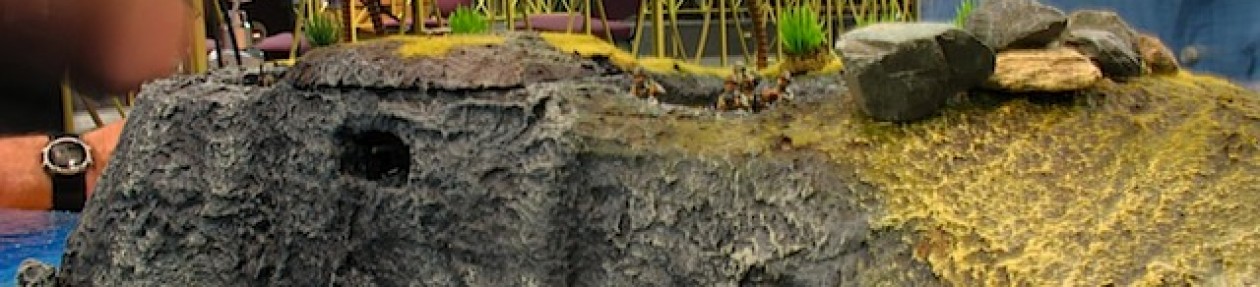
The basic development of EoTRS scenarios centers around Arc of Fire. That does not mean the scenarios cannot be modified for other rule systems. However, in my humble opinion, Arc of Fire tends to lean more towards a European Theater flavor. Hence, modifications and additions have been made to the core rule set in order to add the “Pacific” flavor. Of course, you have the option of playing with or without the modifications.
Hand-to-Hand Combat (DRAFT)
Idea
There are several instances where Japanese and American soldiers got into a knock-down, all out brawl. In most cases, someone died if not both soldiers. The goal of this rule is to introduce a true hand-to-hand combat sub-system that takes into consideration several factors including melee style weapons, training, element of surprise, bonzai, morale, etc. The system uses a D10 system with modifiers.
Rule
First, compare the training values between the Japanese soldier(s) and the American soldier(s) involved (used the higher if multiple soldiers are attacking a single soldier [never more than 2 vs 1]). If the training is equal, then both soldiers will roll a single D10 and add/subtract modifiers and compare to combat result table. If one soldier is higher training (lower number) than the other soldier, the higher trained soldier rolls additional D10s based on the difference between the training values.
Example 1
* If the American soldier has a training value of 6 and the Japanese soldier has a training value of 5, then the American soldier rolls 1D10 and the Japanese soldier rolls 2D10s (TAC: 6-5=1|1D10+1 bonus=2D10).
Example 2
* If the American soldier has a training value of 6 and the Japanese soldier has a training value of 6, then the American soldier rolls 1D10 and the Japanese soldier also rolls 1D10.
Example 3
* If there are two American soldiers (one has a training value of 5 and the other has a training value of 6) and the Japanese soldier has a training value of 6, then the American player takes the higher trained soldier, 6, and uses that. The American player rolls 2D10s (TAC:6-5=1|1D10+1 bonus=2D10) and the Japanese soldier rolls 1 D10.
Next, add the modifiers to the highest die rolled according to the table below:
Element Modifier
- Banzai Charge +2
- Charging +1
- Melee Style Firearms (Pistol, Submachine Gun,etc) +2
- Bladed weapons (Sword, KBar, Bayonet,etc) +1
- All other weapons (Rifle, etc.) +0
- No weapons -1
- Confused -1
- Broken -2
- Leader +1
- Light Wound -1
- Heavy Wound -3
- Assistance +2
- Heroic +1
Lastly, compare to highest die value to the chart below:
| Die Roll | Result |
| <0 | No effect |
| 1-2 | Morale Check |
| 3-4 | Morale Check-1 |
| 5-6 | Light Wound |
| 7-8 | Heavy Wound |
| 9+ | Dead |
If both soldiers are alive, then perform a second round of combat with results from the first. If both soldiers are still alive, it is a lock. If there is another soldier assisting, they are also counted in the round. If the soldier it is assisting goes down (KIA, WIA, Broken), then the assistant takes a morale check to see if he remains assisting. Note also, that the charge/banzai is only in effect for the first round of combat. In addition, during a combat where there are multiple possible targets, a random die roll is used to determine who the primary defender is.
If the attacker kills the defender, then the attacker is awarded 3 points. If the defender kills the attacker, then the defender is awarded 1 point.
Example 1
Japanese soldier (T-5/M-C/Rifle) charges into a fox hole with two Marines (T-5/M-B/Submachine & T-6/M-C/Rifle). A melee ensues.
First, determine who the defender is going to be. It turns out after rolling odd, it is the Marine carrying the Submachine gun. Second, compare training values:
* Japanese soldier gets 1D10 as does the American soldier due the training values being equal
Third, calculate modifiers:
* Japanese soldier: gets +1 for charging, +0 for carrying a weapon resulting in a total +1 to his die roll.
* Marine soldier: gets +2 for carrying a melee style weapon (submachine gun) , +2 for assistance resulting in a total +4 to his die roll.
Japanese (+1) || American (+4)
9+1=11 || 6+4=10
Dead || Dead
3 pts || 1 pts
Example 2
Japanese leader carrying a sword bonzai charges into a fox hole with two Marines. One Marine is present carrying a BAR. A melee ensues.
Japanese player gets +2 for bonzai charging, +1 for carrying a weapon, +1 for being a leader resulting in a net +4 to his die roll Marine player could either get +1 for carrying a weapon (BAR) resulting in a net +1 to his die roll
Japanese (+4) || American (+1)
1+4=5 || 10+1=11
Light Wound || Dead
0 pts || 1 pts
Wound/Wound Management/Corpsman
Idea
When a soldier gets wounded during combat, wounds can either be a scratch, something that hinders performance, or potentially fatal. During many battles, Navy Corpsmen helped tend to the wounded. In certain cases, light wounds which hindered the soldier were treated and brought the soldier back to full strength. In other cases, heavy wounds, if not treated, resulted in death. These additional optional rules are intended to capture the importance of wound management and the corpsman.
Rule
The Marine player is permitted to use corpsman and may initially place them anywhere within their deployment zones. During the game, corpsman may be activated on their assigned card to attempt to heal the wounded. A corpsman has 16” of total movement (double for large scale). The cost per attempt is 4” (double for large scale). A corpsman may try several times on the same soldier or multiple soldiers. Marines that are lightly wounded can be healed back to full strength and but still broken. Marines that are heavily wounded are healed back to wounded strength and broken. Marines that are not healed during rally phase may be downgraded. Use the following chart:
| D10 | Result |
| 1-5 | Remain at same state |
| 6-10 | Downgrade Light to Heavy or Heavy to Dead |
During an attack, when a wound is received, refer to the following chart to determine effect:
| D10 | Result |
| 1-2 | “Just a scratch!”, perform a Morale-1 check |
| 3-7 | Light wound, mark figure with a single wound marker |
| 8-10 | Heavy wound, mark figure with a double wound marker |
Corpsman are single figures that cannot be targeted during movement.
Japanese did not have field medics (or none that I am aware of). Hence, a heavy wound count as a death.